

Apios americana (Glycine tubereuse) — glycine tubereuse

- Family :Fabaceae
- Subfamily :
- Common name :glycine tubereuse
- Section :
- Native to : Asie et Amérique du Nord
- Native climate :temperate maritime
- Colour :Pink
- Hardiness :good
- Exposure :half-shade
- Storage organ :tuber
- Growth :winter grower
- Flowering height :150+ cm
- Uses :In the ground - Containers or pot - Climber
The genus
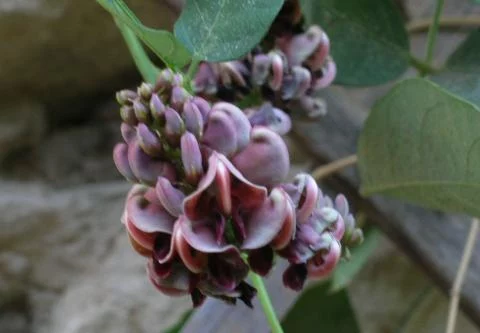
A leguminous, gracefully twining perennial with the common name of "tuberous wisteria" which adequately illustrates the general aspect of the plant. The pleasantly fragrant "papilionaceous" flowers form dense spikes in the leaf axils. The leaves are pinnate with each one being divided into 3 to 9 leaflets.
Taken from : http://www.bio.umass.edu/biology/conn.river/groundnt.html
The groundnut is probably the most famous edible wild plant in eastern North America. The species range is very broad, from Ontario and Quebec in the north to the Gulf of Mexico and from the prairies in the west to the Atlantic coast. The Amerindians throughout this area utilized Apios americana as a major food resource. In fact, it is still common to find these plants growing over old Amerindian village sites.
Early European explorers and colonists of North America often depended upon the groundnut for their survival. In the 1580s, colonists of Sir Walter Raleigh's settlement on Roanoke Island off the coast of North Carolina (the famous "Lost Colony" and the home of Virginia Dare, the first English child born in the New World) sent samples of Apios to Queen Elizabeth I. In 1607, Captain John Smith of Jamestown (Virginia), wrote of the utility of this plant. The Pilgrims of Plymouth (Massachusetts) (1623) survived on groundnut when their corn supply was exhausted. Groundnut was so important to the colonists of the Connecticut River valley that in 1654, the town of Southampton passed a law that prohibited Amerindians from digging groundnut on "English-Lands." The first offense was punishable by a period in the stocks; for the second offense, the culprit was whipped! One wonders if this law is still on the books.
In the 19th century, probably the most famous advocate of Apios was Henry David Thoreau who noted that groundnut was better boiled than roasted. Thoreau presumably made this culinary discovery during his sojourn as a homeless person along the shore of a pond in eastern Massachusetts.
(For inquiries contact Ed Klekowski, Professor, Biology Department, University of Massachusetts Amherst )
Growing cycle
| Jan | Fév | Mar | Avr | Mai | Jun | Jul | Aoû | Sep | Oct | Nov | Déc | |||||||||||||||||||||||||||||||||||||
|---|---|---|---|---|---|---|---|---|---|---|---|---|---|---|---|---|---|---|---|---|---|---|---|---|---|---|---|---|---|---|---|---|---|---|---|---|---|---|---|---|---|---|---|---|---|---|---|---|
| Plantation | ||||||||||||||||||||||||||||||||||||||||||||||||
| Végétation | ||||||||||||||||||||||||||||||||||||||||||||||||
| Floraison | ||||||||||||||||||||||||||||||||||||||||||||||||