

Lilium auratum
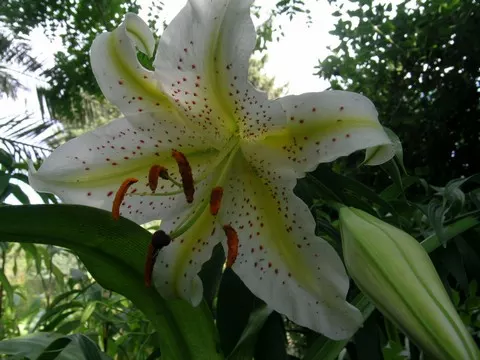
0306 JBryan: L. auratum is one of my favorites and a long time resident of many gardens. Introduced in 1862 from Japan, it was responsible for the poor reputation lilies had for many years as being difficult to grow. The reason being the roots were often removed prior to packing, and in transit they lost much moisture resulting in poor quality bulbs being sold. Modern transport and packing methods plus being raised from seed in this country enables top quality bulbs to be purchased. The height the species can reach is quite amazing, 7 feet not being unusual and reaching over 10 feet in ideal conditions. The large flowers, 8-10 inches in diameter, are carried on down and outward facing pedicels. The flowers are bowl-shaped and the crimson spots accentuate the pure white with a golden central band of the tepals and one flower will produce so much fragrance that it is almost unbelievable. There are several varieties. L.a. var. platyphyllum is possibly the most commonly grown and the tallest. Var. pictum has a crimson & gold center stripe and var. rubrovittatum has a crimson central band. Var. virginale is pure white with just a hint of gold in the median stripe. 11/99 sir Peter Smithers: At a meeting of the Liliy Committee of the RHS in its early days before WWII they were served at the luncheon break with a dish of Lilium auratum. In fact in Japan I believe that this was a commonly sold L.auratum had more to do with the kitchen than with the Nursery Trade.
Le genre
Originaires de régions montagneuses avec un climat plus froid, la plupart des lys sont à végétation estivale. Pour cultiver des lys dans un climat méditerranéen, il faut donc choisir des emplacements mi-ombragés. Leurs bulbes sont très résistants au gel et il est préférable de les conserver enterrés pendant l'hiver. Les racines des lys sont souvent superficielles et un paillage est bénéfique pour leur conserver une certaine fraîcheur pendant l'été. Quelques espèces à végétation hivernale, originaires d'un climat méditerranéen sont disponibles pendant l'été.
- Famille :Liliaceae
- Sous-famille :Liliaceae
- Pays d'origine :Japon
- Climat d'origine :tempéré maritime
- Couleur :Crème
- Organe de réserve :bulbe
- Végétation :végétation estivale
- Hauteur floraison :150+ cm
- Utilisations :En pleine terre
Cycle de végétation
| Jan | Fév | Mar | Avr | Mai | Jun | Jul | Aoû | Sep | Oct | Nov | Déc | |||||||||||||||||||||||||||||||||||||
|---|---|---|---|---|---|---|---|---|---|---|---|---|---|---|---|---|---|---|---|---|---|---|---|---|---|---|---|---|---|---|---|---|---|---|---|---|---|---|---|---|---|---|---|---|---|---|---|---|
| Plantation | ||||||||||||||||||||||||||||||||||||||||||||||||
| Végétation | ||||||||||||||||||||||||||||||||||||||||||||||||
| Floraison | ||||||||||||||||||||||||||||||||||||||||||||||||